BioHub

The Biodiversity and Ecosystems research domain (BioHUB) advances an integrated scientific and technological agenda aligned with the European Green Deal, the Sustainable Development Goals, and the Kunming-Montreal Global Biodiversity Framework. Its focus is the assessment and protection of biodiversity across all levels of biological organisation, from genetic diversity within populations to species, habitats, and whole ecosystems, together with the services they provide to human societies. By combining Earth Observation, state-of-the-art bioinformatic and ecoinformatic workflows, Artificial Intelligence, and climate modelling, the domain quantifies biodiversity patterns and their responses to global environmental change from local to continental scales. Its goal is to translate fundamental research into applied biodiversity science and operational solutions for decision makers.
A primary research activity uses Earth Observation, large scale biodiversity databases, and deep learning and large foundation models to detect and predict ecosystem responses to long-term climate change and to seasonal climate variability and extremes such as droughts, heatwaves, and floods, in protected areas across Europe (NATURA 2000). Our center coordinates the Horizon funded e-genesis project, which delivers seasonal forecasts of grassland and wetland responses to climate exposure, long-term trends in vegetation and water content indicators since the 1980s, and a composite health indicator per habitat type. We develop satellite-derived biodiversity indicators that link habitat types and their characteristic species to open biodiversity databases, and we quantify how the composition and functional structure of protected ecosystems shift under climate extremes and human pressures. These products enable real-time monitoring of conservation status and timely policy action, with generative AI and large language models translating detected ecological impacts into conservation and risk mitigation recommendations for protected area authorities.
Genetic diversity is the foundation of biodiversity and a core target of the Kunming-Montreal Global Biodiversity Framework, yet it remains the least monitored of its levels. A further research activity addresses this gap through the genomic fingerprinting of biodiversity across space and time, resolving the genetic responses of species and communities to climate and land use change. Using museum genomics, we compare historical herbarium collections with modern populations of threatened plant species to track genomic erosion and functional change over decades. In addition, through soil metagenomics, we characterise the diversity and functional structure of microbial communities and link them to environmental and climatic gradients at continental scale. Together these approaches reveal how the genetic basis of resilience is being reshaped by global environmental change, and they deliver the evidence base for safeguarding genetic diversity in conservation and restoration policy.
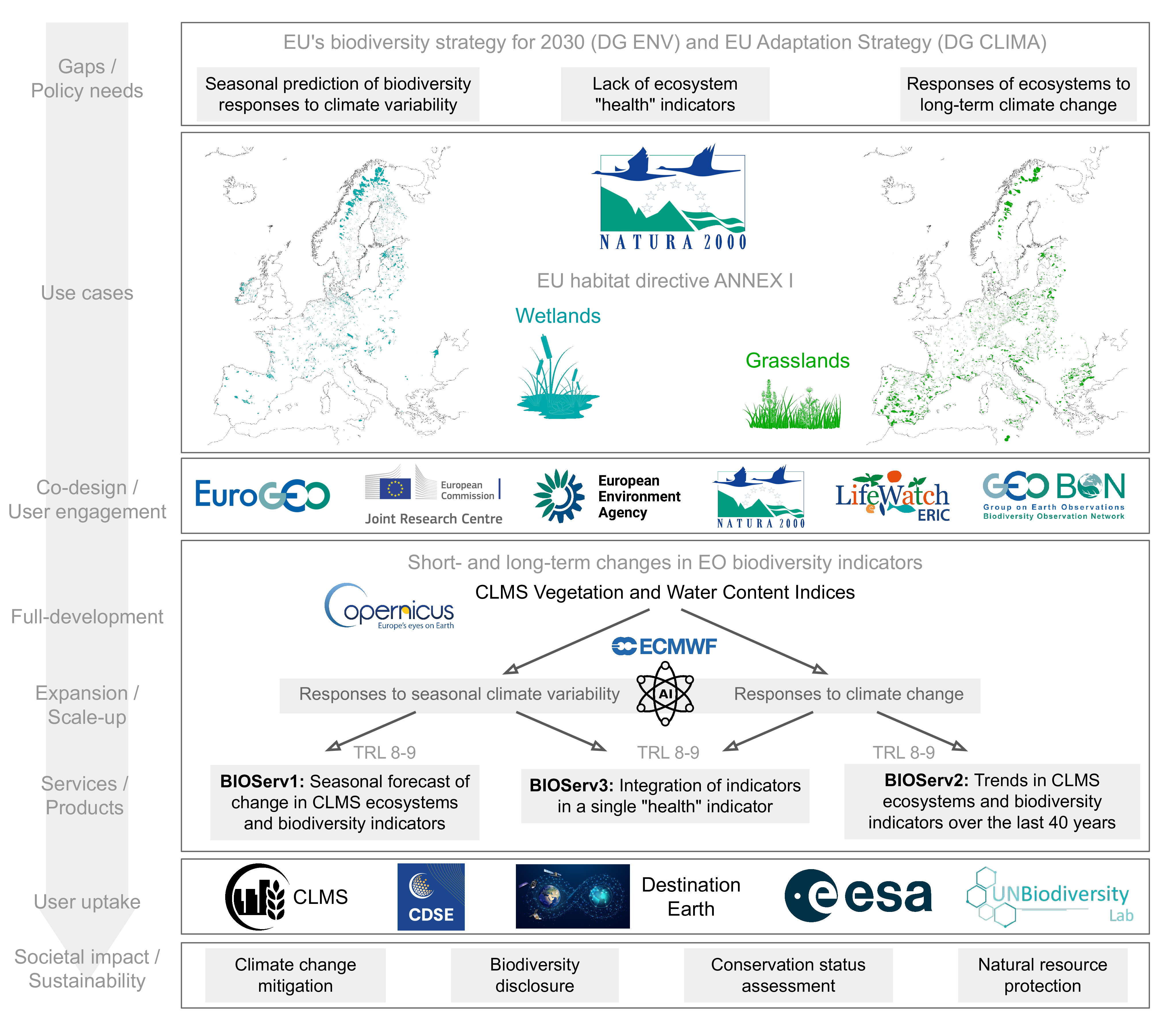
The e-genesis workflow, which informs biodiversity policy by assessing long-term and seasonal ecosystem responses to climate change and variability and by delivering data-driven ecosystem health indicators.
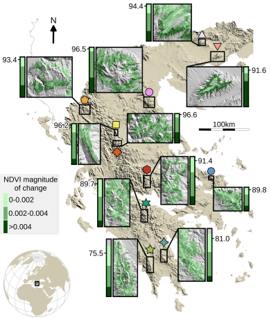
Climate and land-use change drive shifts in vegetation cover across the Greek mountains. The map on the left uses 40 years of satellite data to show vegetation change trends. These changes have adverse effects on biodiversity and genetic resources, as shown by the correlation in the scatter plot on the right. The case study draws on museum genomics of the medicinal plant Ironwort (Sideritis), from Theodoridis et al. 2025.
Spyros Theodoridis, sp.theodoridis@noa.gr